Onboarding
Helping more users reach the app homepage.

Holistic UX
Cross-functional Influence
At a glance
Scope
Product design strategy, problem and solution discovery, and end-to-end experience design for improving the shopping app onboarding experience.

Impact & contribution
Improved homepage reach from 70% to 74%, Reframed onboarding from a sequence of setup screens into a strategic entry point to Decathlon’s digital ecosystem.
Decathlon identified that onboarded users had significantly higher business value, especially users who were logged in or already familiar with the Decathlon ecosystem. However, close to 30% of users who downloaded the app were not reaching the homepage, creating a major drop-off at the very beginning of the funnel
I led the design strategy to understand where users were dropping, why the onboarding experience lacked motivation, and which opportunities could create the biggest user and business impact. By combining funnel data, UX audit findings, user research, and cross-functional workshops, I helped the team move from a broad onboarding problem to a prioritized opportunity roadmap.
The work improved the percentage of users reaching the homepage from 70% to 74% and created a foundation for larger follow-up opportunities, including removing mandatory guest store selection, simplifying login/account creation, and making onboarding feel more connected to Decathlon’s broader digital ecosystem.
The onboarding challenge was not only that users were dropping off. The deeper issue was that the app was asking users to complete setup steps before clearly showing them the value of continuing.
Through the user research and data analysis insights, I helped identify three core problems.
Too many users were leaving before reaching the homepage
Close to 30% of users who downloaded the app failed to reach the homepage. This was a major issue because it happened at the earliest stage of the customer journey, before users could experience product value.
Guest users faced unnecessary friction
Guest users had to select a store before reaching the homepage. This created friction in a path that should have been fast and low-commitment. Analysis showed a significant business opportunity linked to guest-path drop-off.
The experience lacked a clear emotional or functional payoff
User research showed that onboarding was perceived as simple, but not memorable. Users expected something more welcoming, useful, or rewarding from Decathlon, a “reason to continue.”
They were willing to share information like location, sport interests, or store preference, but only when it felt optional, transparent, and immediately valuable.
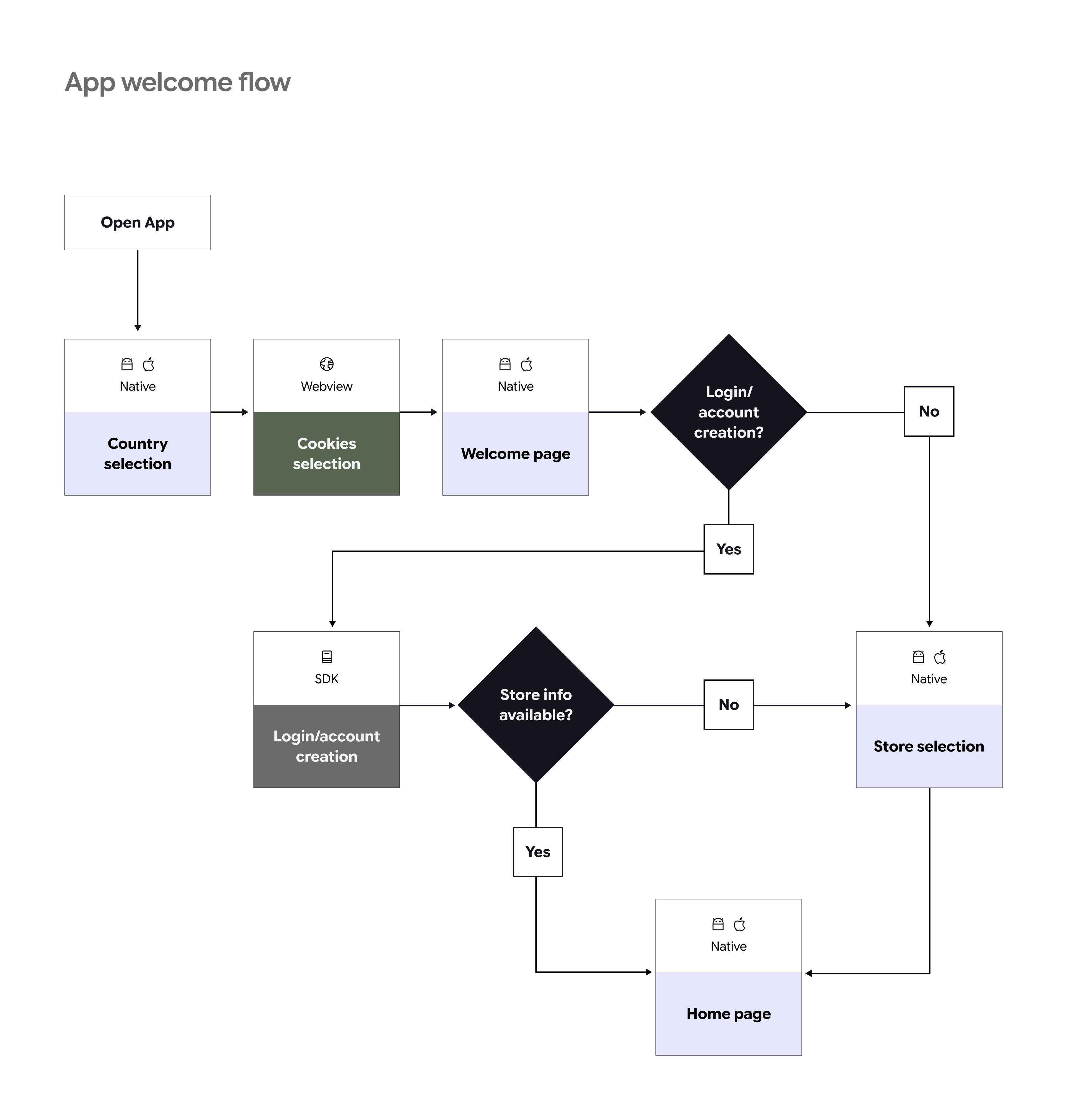
Mapping the full welcome flow helped reveal how many decisions users had to make before reaching the homepage.
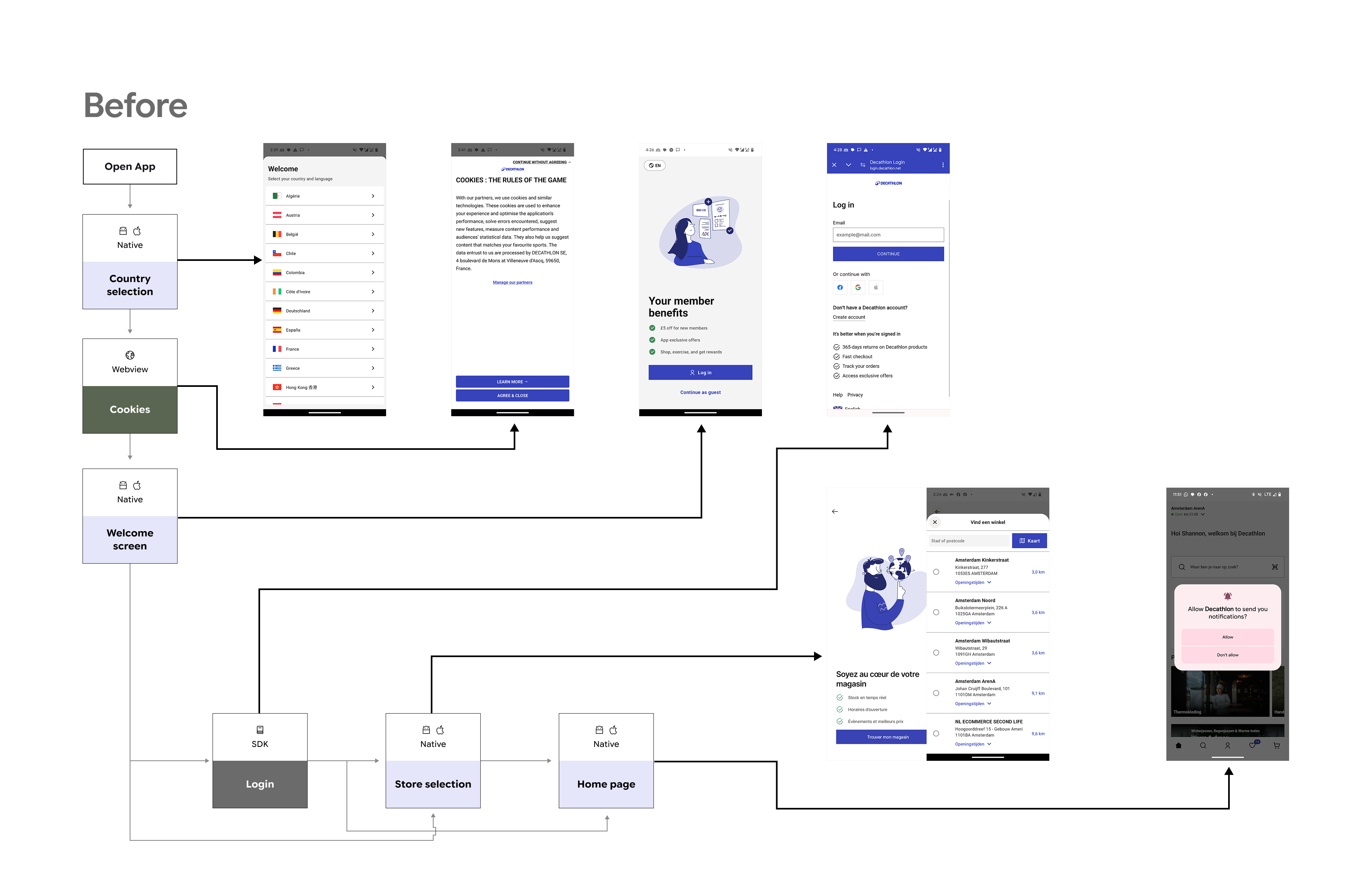
The audit revealed that users were asked to make several setup decisions before experiencing the value of the app.
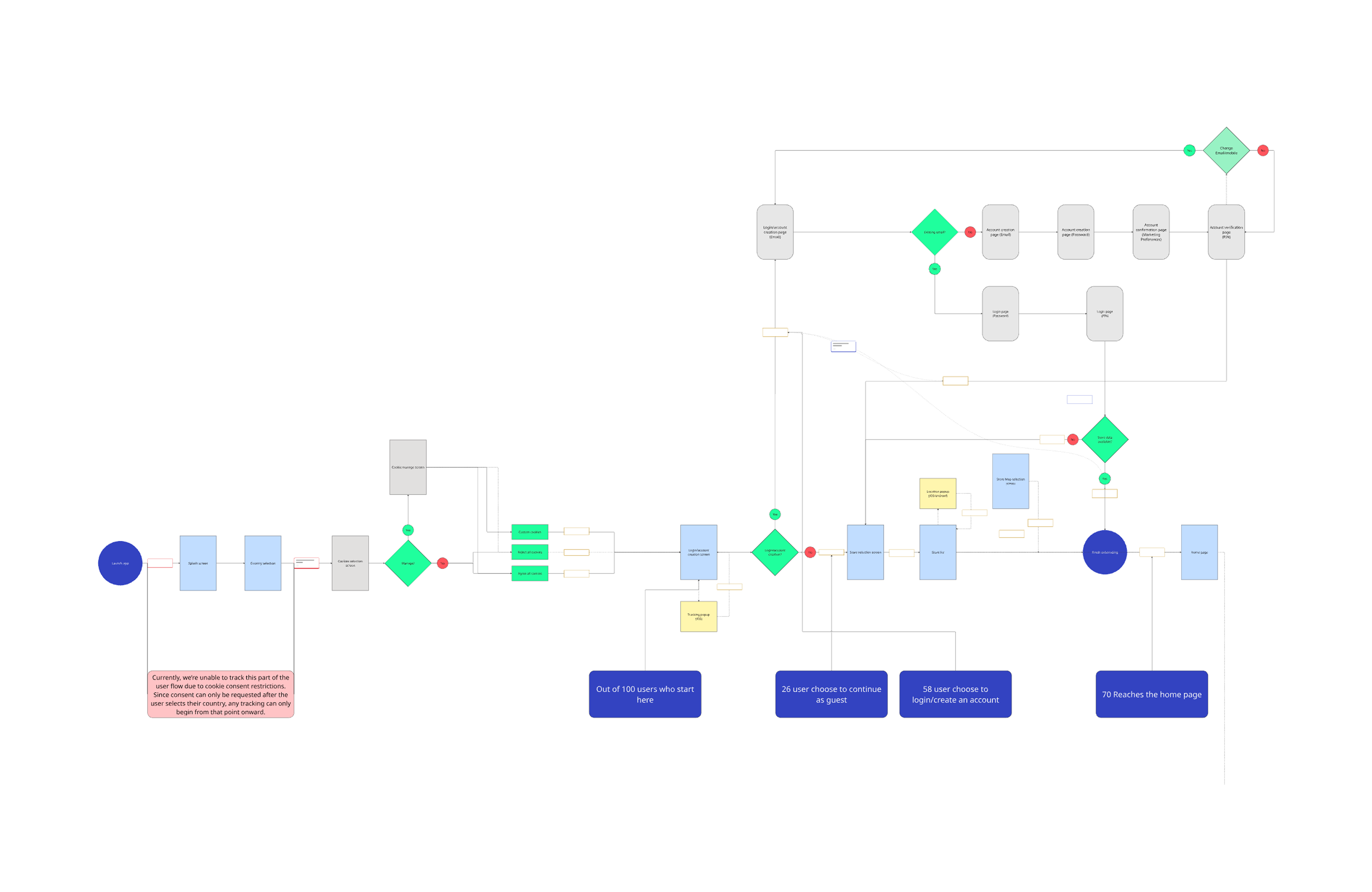
By combining flow mapping with funnel data, I helped the team identify onboarding as a high-impact entry journey where small improvements could create meaningful downstream value.
Create visibility into the onboarding funnel
I worked with the Analytics team to map the complete onboarding flow and identify the critical paths users were taking. This helped the team understand where users were dropping and which decisions mattered most.
This shifted the conversation from “how do we improve onboarding screens?” to “which onboarding decisions create the biggest user and business impact?
Translate research and data into opportunity areas
Using research insights, UX audit findings, and funnel data, I led an opportunity framing workshop to define the main customer needs behind the drop-off.
Prioritize what to solve now vs later
The onboarding space was broad, with many possible improvements. I led prioritization with Product and Engineering using impact-effort mapping, helping the team separate near-term viable improvements from larger system-level opportunities that required other squads.
This helped us move faster without losing the broader vision.
Turn opportunities into testable solutions
I led solution discovery workshops, including Crazy 8 ideation, and worked with the Product Manager and Engineering Manager to prioritize the strongest concepts. I then partnered with Content Design on tone, clarity, and guidance, created prototypes, and validated the solutions with User Research to de-risk rollout.
To keep the broader strategy visible, I mapped opportunities, sub-opportunities, and solutions into an opportunity-solution tree for follow-up discovery.
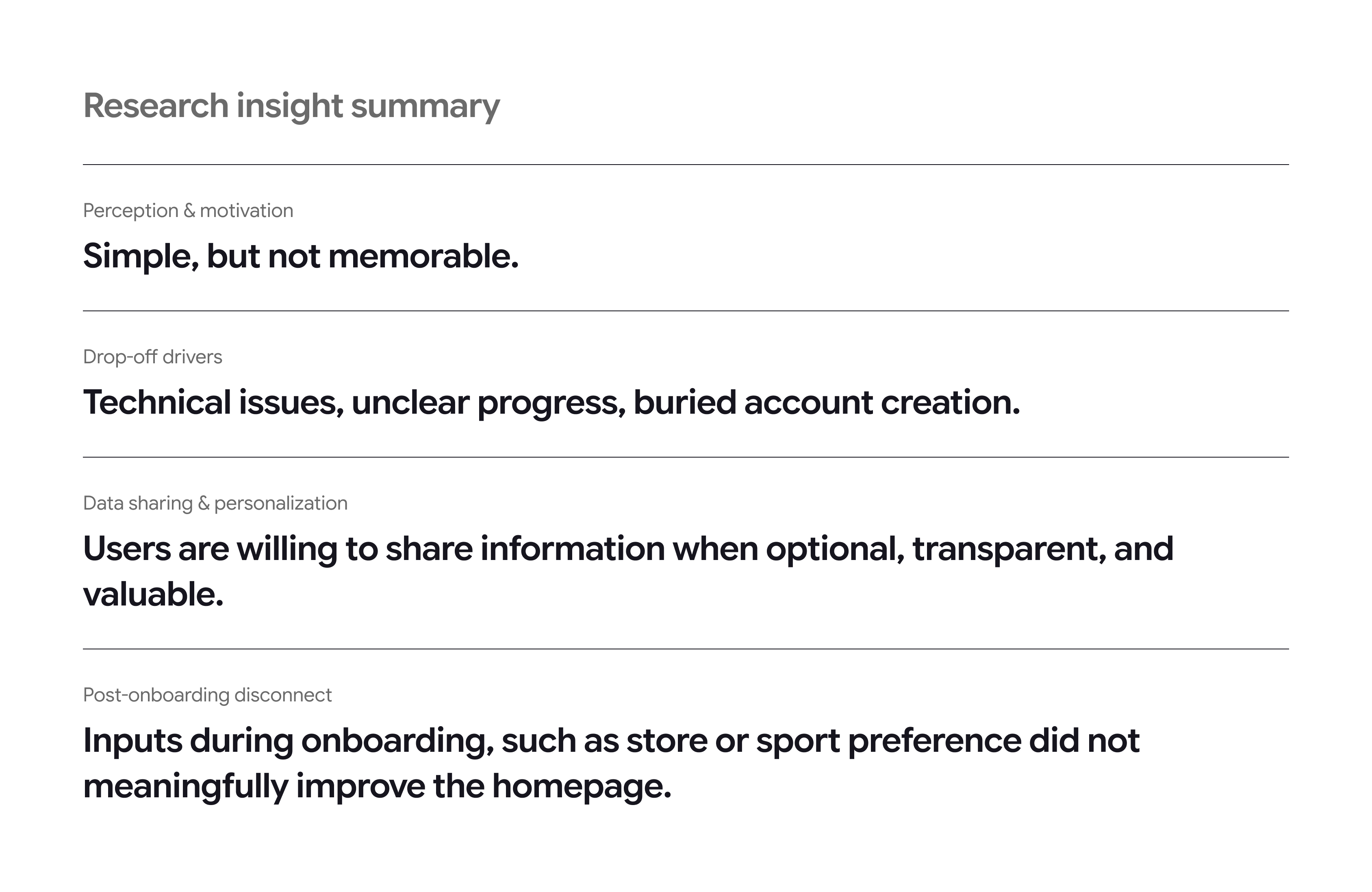
Research revealed that onboarding was simple, but not motivating enough: users needed clearer value, more control, and a stronger connection to what the app could offer.
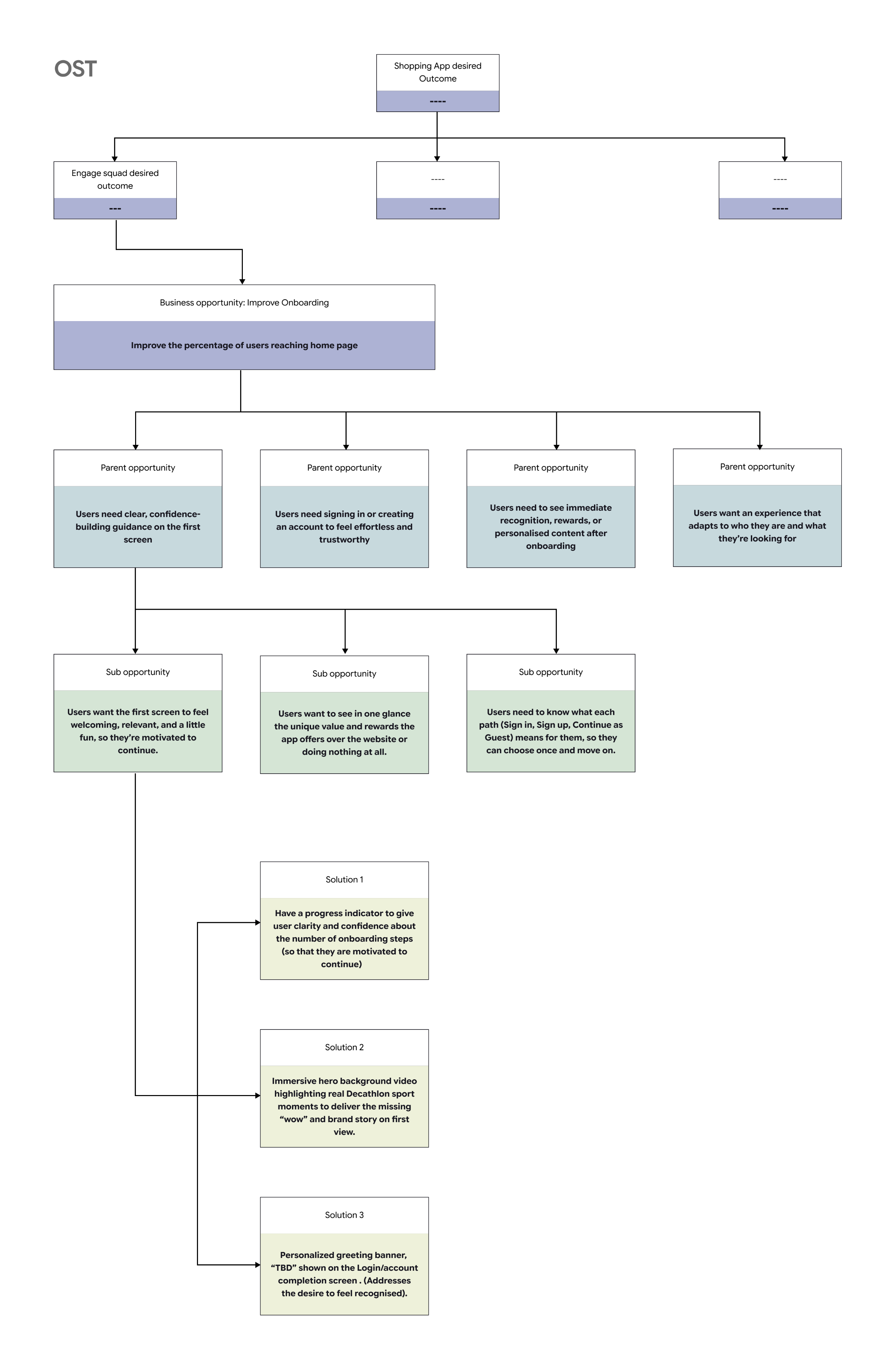
I translated research and funnel signals into opportunity areas, helping the team prioritize what to solve now and what to explore next.
Reframe onboarding as ecosystem entry, not just app setup
I reframed the problem from “users need to complete onboarding” to:
How might we help users feel welcomed, guided, and motivated to enter Decathlon’s digital ecosystem?
This helped the team think beyond landing users on the homepage and consider how onboarding could support loyalty, personalization, store connection, and future engagement.
Focus the viable scope on homepage reach
The broader vision was to onboard users into Decathlon’s ecosystem, but the most immediate viable opportunity was improving the percentage of users reaching the homepage.
This gave the team a clear measurable goal while keeping the larger onboarding vision alive.
Make the login / guest decision clearer and more motivating
The login/guest selection page was a critical point in the journey. I led the design direction to make this screen more welcoming, clearer, and more guided.
We also tested different content directions and created guidance for app countries to use more effective onboarding messaging.
Reduce forced decisions before value is shown
The audit showed that users were being asked to make setup decisions too early, such as selecting country, language, cookies, and store preference.
I pushed for reducing unnecessary friction by
- Pre-selecting country and language where possible
- Letting users confirm or adjust with one tap
- Simplifying cookie content so it felt easier to process
- Challenging the need for mandatory store selection before homepage entry
This was important because users should not feel blocked before experiencing the value of the app
Treat dependencies as influence opportunities
Some of the biggest opportunities were outside our direct squad scope.
For example, login/account creation was managed by another team, and removing store selection had dependencies across homepage, PDP, and other flows. Rather than treating these as blockers, I used the evidence to align other squads around the user and business impact.
This helped influence the Login team’s roadmap and created alignment around removing guest store selection as a next step.
Final solution
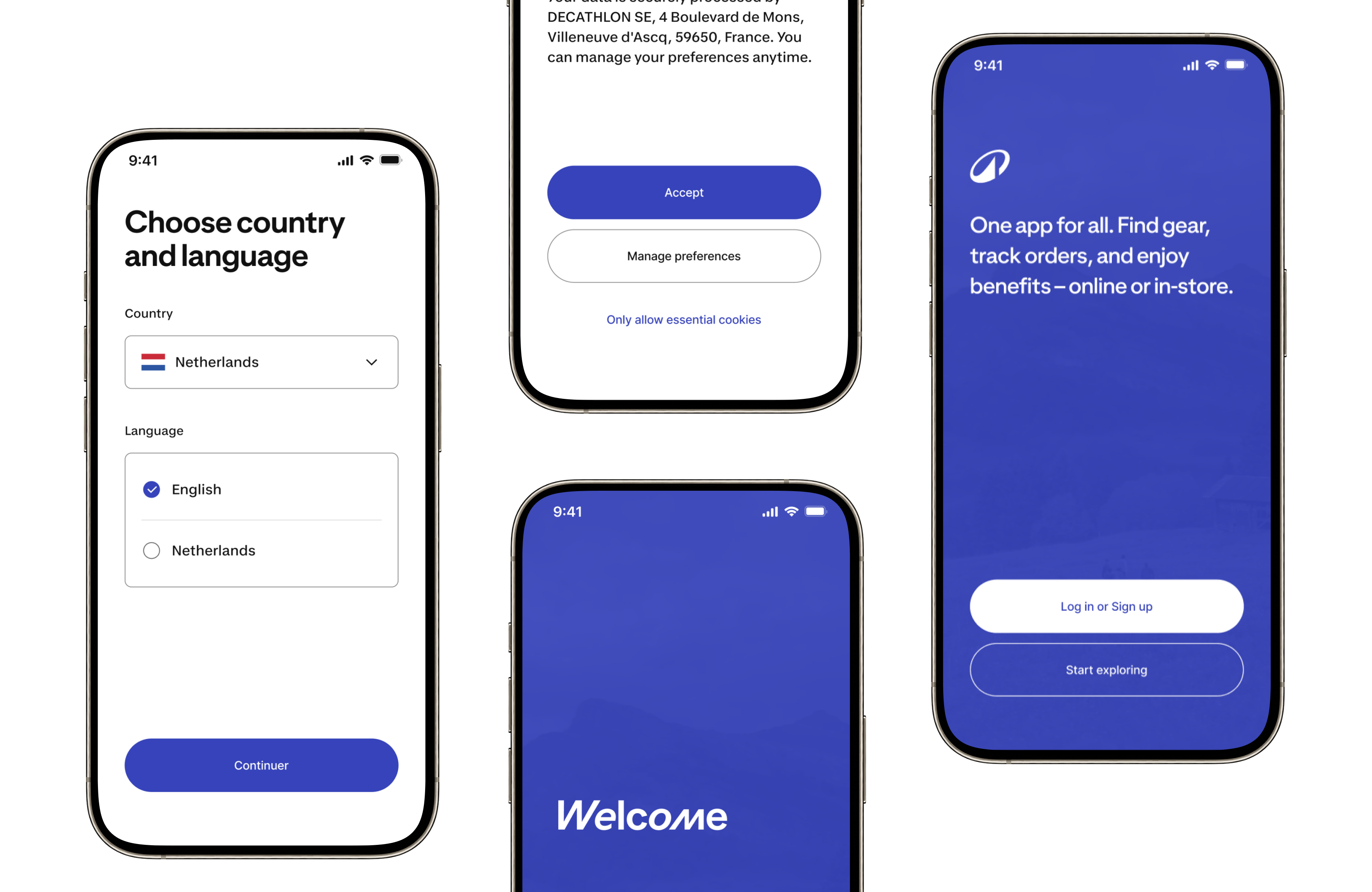
The final solution focused on reducing early friction, making key choices clearer, and creating a more welcoming path into the app.
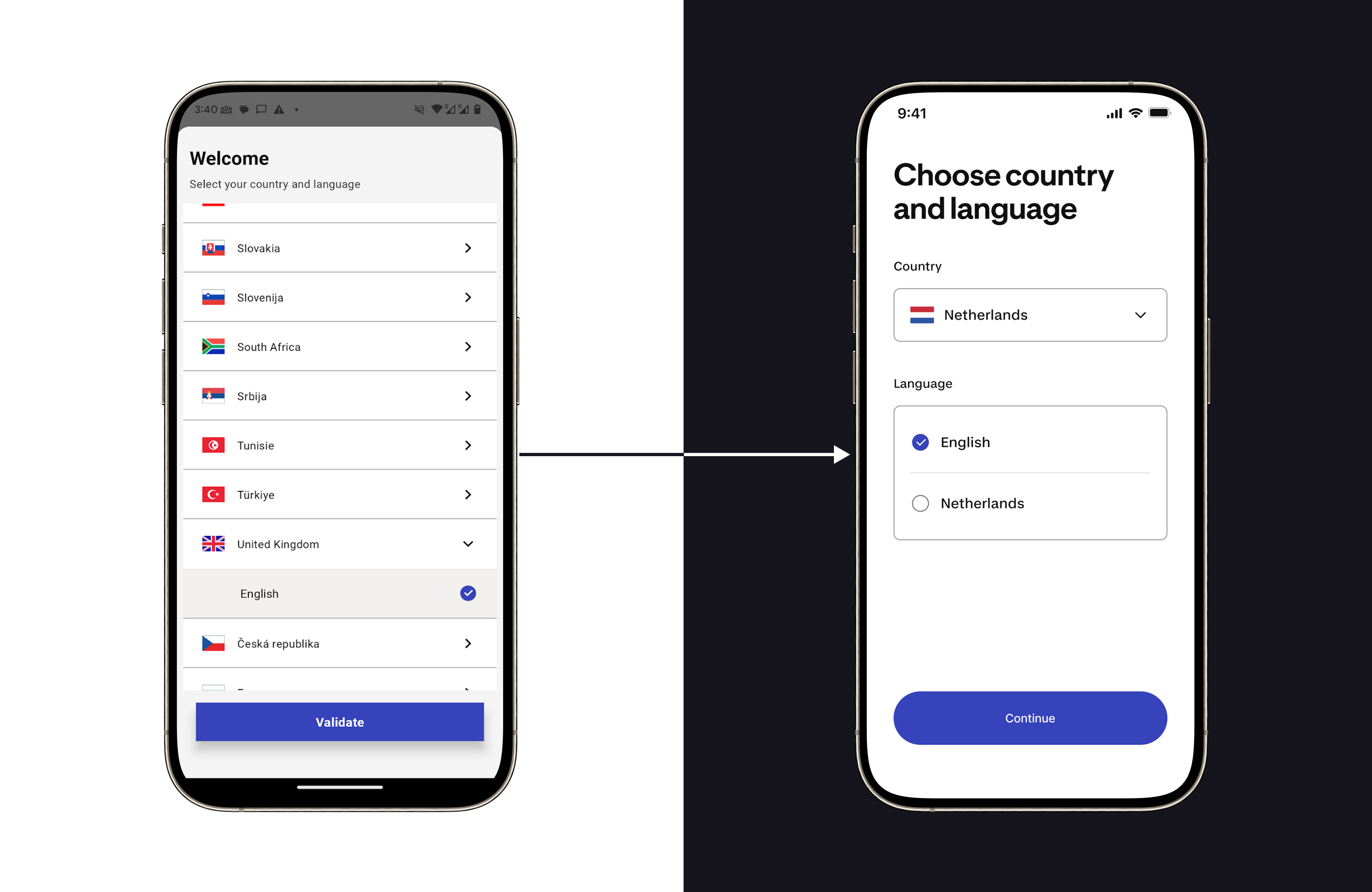
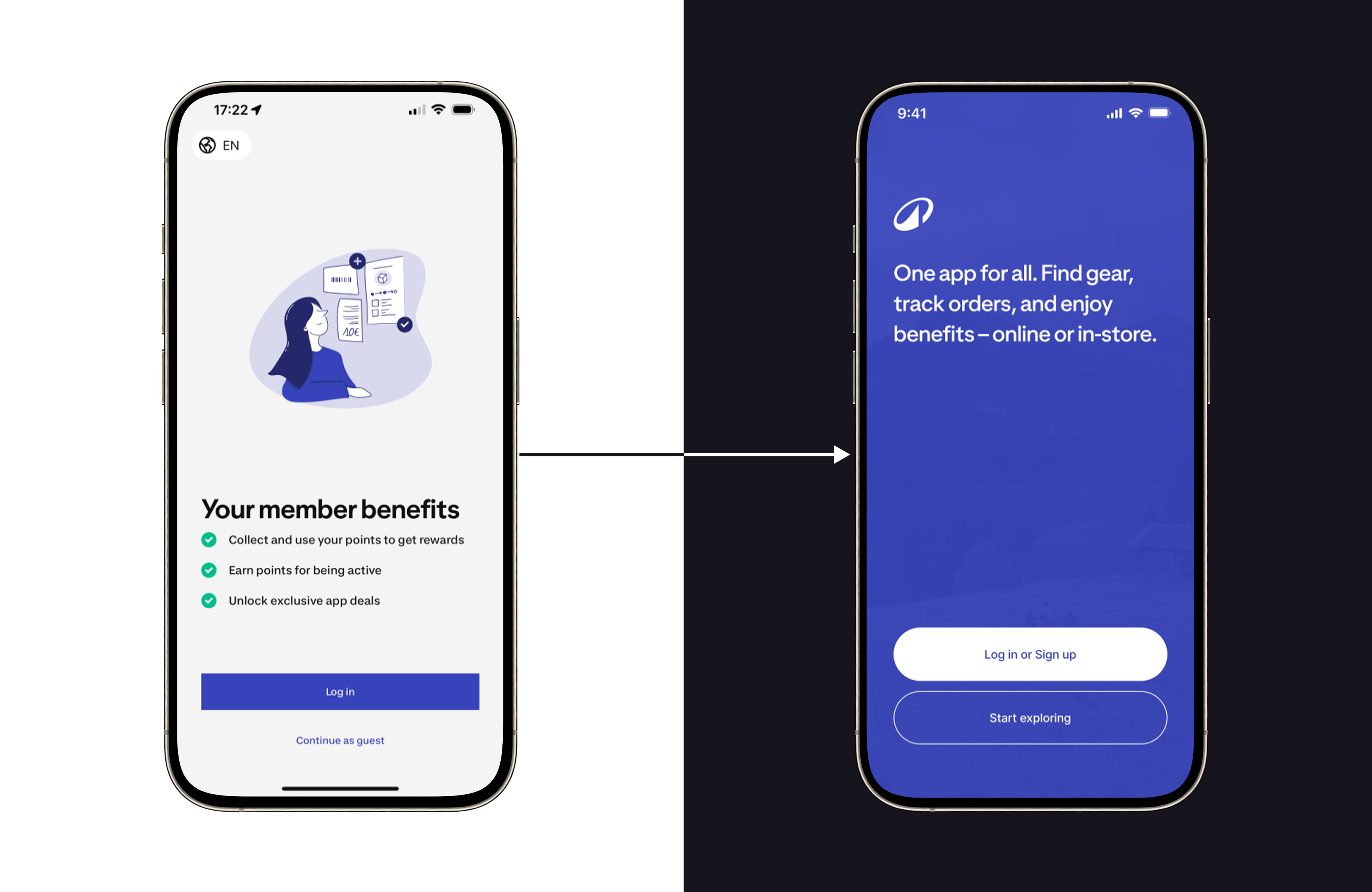
Core onboarding screens before and after, showing clearer setup choices and a more guided login/guest decision moment.
Prototype comparing feasible, viable, and desirable onboarding flows: from improving the current path, to removing mandatory store selection, to a future experience with minimal setup before homepage entry.
Impact
Business impact
Improved homepage reach from 70% to 74%.
Product impact
The work gave the team a clearer decision-making framework for onboarding. Instead of treating onboarding as a set of screens, we created a structured opportunity map connecting user needs, business value, and technical dependencies.
User impact
The onboarding experience became clearer, more guided, and easier to continue through. Users had a better understanding of their options and faced less friction before reaching the homepage.
Strategic impact
The work helped shift onboarding from a narrow funnel problem to a broader product strategy question: How do we make new users feel welcomed, recognized, and connected to Decathlon from the moment they open the app?
Continuous improvement
Expanding onboarding beyond the first session
The onboarding work created impact beyond the initial flow improvements. By framing onboarding as the user’s entry point into Decathlon’s wider digital ecosystem, we identified follow-up opportunities across store selection, login/account creation, and member engagement.
Removing unnecessary store selection
Aligned with the Navigate squad to evaluate the impact of removing mandatory store selection from the guest path. The team completed the impact study and the decision is moving toward store removal, reducing early friction before users reach the homepage.
Simplifying login and account creation
Shared the onboarding opportunities identified during our workshop with the Login team and connected them to their opportunity-solution mapping. This helped support prioritization of improvements such as password-less login and fewer account creation steps, making the welcome flow faster and less effortful.
Connecting onboarding to membership value
Worked with the Member team to look at onboarding more holistically, Not only as a setup flow, but as a way to connect users to Decathlon’s broader ecosystem. The next step is to map the most relevant member opportunities to specific app journey touchpoints.
Together, these initiatives move the app closer to our desired onboarding experience: helping users feel welcomed, recognized, and guided toward the right next step from the moment they enter the app.
The takeaway
This work helped reframe onboarding from a setup flow into a key entry point to the Decathlon app experience. It improved homepage reach from 70% to 74% and created clearer follow-up opportunities across login, store selection, and membership.
Onboarding
Helping more users reach the app homepage.

Holistic UX
Cross-functional Influence
At a glance
Scope
Product design strategy, problem and solution discovery, and end-to-end experience design for improving the shopping app onboarding experience.

Impact & contribution
Improved homepage reach from 70% to 74%, Reframed onboarding from a sequence of setup screens into a strategic entry point to Decathlon’s digital ecosystem.
Decathlon identified that onboarded users had significantly higher business value, especially users who were logged in or already familiar with the Decathlon ecosystem. However, close to 30% of users who downloaded the app were not reaching the homepage, creating a major drop-off at the very beginning of the funnel
I led the design strategy to understand where users were dropping, why the onboarding experience lacked motivation, and which opportunities could create the biggest user and business impact. By combining funnel data, UX audit findings, user research, and cross-functional workshops, I helped the team move from a broad onboarding problem to a prioritized opportunity roadmap.
The work improved the percentage of users reaching the homepage from 70% to 74% and created a foundation for larger follow-up opportunities, including removing mandatory guest store selection, simplifying login/account creation, and making onboarding feel more connected to Decathlon’s broader digital ecosystem.
The onboarding challenge was not only that users were dropping off. The deeper issue was that the app was asking users to complete setup steps before clearly showing them the value of continuing.
Through the user research and data analysis insights, I helped identify three core problems.
Too many users were leaving before reaching the homepage
Close to 30% of users who downloaded the app failed to reach the homepage. This was a major issue because it happened at the earliest stage of the customer journey, before users could experience product value.
Guest users faced unnecessary friction
Guest users had to select a store before reaching the homepage. This created friction in a path that should have been fast and low-commitment. Analysis showed a significant business opportunity linked to guest-path drop-off.
The experience lacked a clear emotional or functional payoff
User research showed that onboarding was perceived as simple, but not memorable. Users expected something more welcoming, useful, or rewarding from Decathlon, a “reason to continue.”
They were willing to share information like location, sport interests, or store preference, but only when it felt optional, transparent, and immediately valuable.
Mapping the full welcome flow helped reveal how many decisions users had to make before reaching the homepage.
The audit revealed that users were asked to make several setup decisions before experiencing the value of the app.
By combining flow mapping with funnel data, I helped the team identify onboarding as a high-impact entry journey where small improvements could create meaningful downstream value.
Create visibility into the onboarding funnel
I worked with the Analytics team to map the complete onboarding flow and identify the critical paths users were taking. This helped the team understand where users were dropping and which decisions mattered most.
This shifted the conversation from “how do we improve onboarding screens?” to “which onboarding decisions create the biggest user and business impact?
Translate research and data into opportunity areas
Using research insights, UX audit findings, and funnel data, I led an opportunity framing workshop to define the main customer needs behind the drop-off.
Prioritize what to solve now vs later
The onboarding space was broad, with many possible improvements. I led prioritization with Product and Engineering using impact-effort mapping, helping the team separate near-term viable improvements from larger system-level opportunities that required other squads.
This helped us move faster without losing the broader vision.
Turn opportunities into testable solutions
I led solution discovery workshops, including Crazy 8 ideation, and worked with the Product Manager and Engineering Manager to prioritize the strongest concepts. I then partnered with Content Design on tone, clarity, and guidance, created prototypes, and validated the solutions with User Research to de-risk rollout.
To keep the broader strategy visible, I mapped opportunities, sub-opportunities, and solutions into an opportunity-solution tree for follow-up discovery.
Research revealed that onboarding was simple, but not motivating enough: users needed clearer value, more control, and a stronger connection to what the app could offer.
I translated research and funnel signals into opportunity areas, helping the team prioritize what to solve now and what to explore next.
Reframe onboarding as ecosystem entry, not just app setup
I reframed the problem from “users need to complete onboarding” to:
How might we help users feel welcomed, guided, and motivated to enter Decathlon’s digital ecosystem?
This helped the team think beyond landing users on the homepage and consider how onboarding could support loyalty, personalization, store connection, and future engagement.
Focus the viable scope on homepage reach
The broader vision was to onboard users into Decathlon’s ecosystem, but the most immediate viable opportunity was improving the percentage of users reaching the homepage.
This gave the team a clear measurable goal while keeping the larger onboarding vision alive.
Make the login / guest decision clearer and more motivating
The login/guest selection page was a critical point in the journey. I led the design direction to make this screen more welcoming, clearer, and more guided.
We also tested different content directions and created guidance for app countries to use more effective onboarding messaging.
Reduce forced decisions before value is shown
The audit showed that users were being asked to make setup decisions too early, such as selecting country, language, cookies, and store preference.
I pushed for reducing unnecessary friction by
- Pre-selecting country and language where possible
- Letting users confirm or adjust with one tap
- Simplifying cookie content so it felt easier to process
- Challenging the need for mandatory store selection before homepage entry
This was important because users should not feel blocked before experiencing the value of the app
Treat dependencies as influence opportunities
Some of the biggest opportunities were outside our direct squad scope.
For example, login/account creation was managed by another team, and removing store selection had dependencies across homepage, PDP, and other flows. Rather than treating these as blockers, I used the evidence to align other squads around the user and business impact.
This helped influence the Login team’s roadmap and created alignment around removing guest store selection as a next step.
Final solution
The final solution focused on reducing early friction, making key choices clearer, and creating a more welcoming path into the app.
Core onboarding screens before and after, showing clearer setup choices and a more guided login/guest decision moment.
Prototype comparing feasible, viable, and desirable onboarding flows: from improving the current path, to removing mandatory store selection, to a future experience with minimal setup before homepage entry.
Impact
Business impact
Improved homepage reach from 70% to 74%.
Product impact
The work gave the team a clearer decision-making framework for onboarding. Instead of treating onboarding as a set of screens, we created a structured opportunity map connecting user needs, business value, and technical dependencies.
User impact
The onboarding experience became clearer, more guided, and easier to continue through. Users had a better understanding of their options and faced less friction before reaching the homepage.
Strategic impact
The work helped shift onboarding from a narrow funnel problem to a broader product strategy question: How do we make new users feel welcomed, recognized, and connected to Decathlon from the moment they open the app?
Continuous improvement
Expanding onboarding beyond the first session
The onboarding work created impact beyond the initial flow improvements. By framing onboarding as the user’s entry point into Decathlon’s wider digital ecosystem, we identified follow-up opportunities across store selection, login/account creation, and member engagement.
Removing unnecessary store selection
Aligned with the Navigate squad to evaluate the impact of removing mandatory store selection from the guest path. The team completed the impact study and the decision is moving toward store removal, reducing early friction before users reach the homepage.
Simplifying login and account creation
Shared the onboarding opportunities identified during our workshop with the Login team and connected them to their opportunity-solution mapping. This helped support prioritization of improvements such as password-less login and fewer account creation steps, making the welcome flow faster and less effortful.
Connecting onboarding to membership value
Worked with the Member team to look at onboarding more holistically, Not only as a setup flow, but as a way to connect users to Decathlon’s broader ecosystem. The next step is to map the most relevant member opportunities to specific app journey touchpoints.
Together, these initiatives move the app closer to our desired onboarding experience: helping users feel welcomed, recognized, and guided toward the right next step from the moment they enter the app.
The takeaway
This work helped reframe onboarding from a setup flow into a key entry point to the Decathlon app experience. It improved homepage reach from 70% to 74% and created clearer follow-up opportunities across login, store selection, and membership.
Onboarding
Helping more users reach the app homepage.

Holistic UX
Cross-functional Influence
At a glance
Scope
Product design strategy, problem and solution discovery, and end-to-end experience design for improving the shopping app onboarding experience.

Impact & contribution
Improved homepage reach from 70% to 74%, Reframed onboarding from a sequence of setup screens into a strategic entry point to Decathlon’s digital ecosystem.
Summary
Decathlon identified that onboarded users had significantly higher business value, especially users who were logged in or already familiar with the Decathlon ecosystem. However, close to 30% of users who downloaded the app were not reaching the homepage, creating a major drop-off at the very beginning of the funnel
I led the design strategy to understand where users were dropping, why the onboarding experience lacked motivation, and which opportunities could create the biggest user and business impact. By combining funnel data, UX audit findings, user research, and cross-functional workshops, I helped the team move from a broad onboarding problem to a prioritized opportunity roadmap.
The work improved the percentage of users reaching the homepage from 70% to 74% and created a foundation for larger follow-up opportunities, including removing mandatory guest store selection, simplifying login/account creation, and making onboarding feel more connected to Decathlon’s broader digital ecosystem.
Problem space
The onboarding challenge was not only that users were dropping off. The deeper issue was that the app was asking users to complete setup steps before clearly showing them the value of continuing.
Through the user research and data analysis insights, I helped identify three core problems.
Too many users were leaving before reaching the homepage
Close to 30% of users who downloaded the app failed to reach the homepage. This was a major issue because it happened at the earliest stage of the customer journey, before users could experience product value.
Guest users faced unnecessary friction
Guest users had to select a store before reaching the homepage. This created friction in a path that should have been fast and low-commitment. Analysis showed a significant business opportunity linked to guest-path drop-off.
The experience lacked a clear emotional or functional payoff
User research showed that onboarding was perceived as simple, but not memorable. Users expected something more welcoming, useful, or rewarding from Decathlon, a “reason to continue.”
They were willing to share information like location, sport interests, or store preference, but only when it felt optional, transparent, and immediately valuable.
Mapping the full welcome flow helped reveal how many decisions users had to make before reaching the homepage.
The audit revealed that users were asked to make several setup decisions before experiencing the value of the app.
By combining flow mapping with funnel data, I helped the team identify onboarding as a high-impact entry journey where small improvements could create meaningful downstream value.
My Approach
Create visibility into the onboarding funnel
I worked with the Analytics team to map the complete onboarding flow and identify the critical paths users were taking. This helped the team understand where users were dropping and which decisions mattered most.
This shifted the conversation from “how do we improve onboarding screens?” to “which onboarding decisions create the biggest user and business impact?
Translate research and data into opportunity areas
Using research insights, UX audit findings, and funnel data, I led an opportunity framing workshop to define the main customer needs behind the drop-off.
Prioritize what to solve now vs later
The onboarding space was broad, with many possible improvements. I led prioritization with Product and Engineering using impact-effort mapping, helping the team separate near-term viable improvements from larger system-level opportunities that required other squads.
This helped us move faster without losing the broader vision.
Turn opportunities into testable solutions
I led solution discovery workshops, including Crazy 8 ideation, and worked with the Product Manager and Engineering Manager to prioritize the strongest concepts. I then partnered with Content Design on tone, clarity, and guidance, created prototypes, and validated the solutions with User Research to de-risk rollout.
To keep the broader strategy visible, I mapped opportunities, sub-opportunities, and solutions into an opportunity-solution tree for follow-up discovery.
Research revealed that onboarding was simple, but not motivating enough: users needed clearer value, more control, and a stronger connection to what the app could offer.
I translated research and funnel signals into opportunity areas, helping the team prioritize what to solve now and what to explore next.
Key decisions I made
Reframe onboarding as ecosystem entry, not just app setup
I reframed the problem from “users need to complete onboarding” to:
How might we help users feel welcomed, guided, and motivated to enter Decathlon’s digital ecosystem?
This helped the team think beyond landing users on the homepage and consider how onboarding could support loyalty, personalization, store connection, and future engagement.
Focus the viable scope on homepage reach
The broader vision was to onboard users into Decathlon’s ecosystem, but the most immediate viable opportunity was improving the percentage of users reaching the homepage.
This gave the team a clear measurable goal while keeping the larger onboarding vision alive.
Make the login / guest decision clearer and more motivating
The login/guest selection page was a critical point in the journey. I led the design direction to make this screen more welcoming, clearer, and more guided.
We also tested different content directions and created guidance for app countries to use more effective onboarding messaging.
Reduce forced decisions before value is shown
The audit showed that users were being asked to make setup decisions too early, such as selecting country, language, cookies, and store preference.
I pushed for reducing unnecessary friction by
- Pre-selecting country and language where possible
- Letting users confirm or adjust with one tap
- Simplifying cookie content so it felt easier to process
- Challenging the need for mandatory store selection before homepage entry
This was important because users should not feel blocked before experiencing the value of the app
Treat dependencies as influence opportunities
Some of the biggest opportunities were outside our direct squad scope.
For example, login/account creation was managed by another team, and removing store selection had dependencies across homepage, PDP, and other flows. Rather than treating these as blockers, I used the evidence to align other squads around the user and business impact.
This helped influence the Login team’s roadmap and created alignment around removing guest store selection as a next step.
Final solution
The final solution focused on reducing early friction, making key choices clearer, and creating a more welcoming path into the app.
Core onboarding screens before and after, showing clearer setup choices and a more guided login/guest decision moment.
Prototype comparing feasible, viable, and desirable onboarding flows: from improving the current path, to removing mandatory store selection, to a future experience with minimal setup before homepage entry.
Impact
Business impact
Improved homepage reach from 70% to 74%.
Product impact
The work gave the team a clearer decision-making framework for onboarding. Instead of treating onboarding as a set of screens, we created a structured opportunity map connecting user needs, business value, and technical dependencies.
User impact
The onboarding experience became clearer, more guided, and easier to continue through. Users had a better understanding of their options and faced less friction before reaching the homepage.
Strategic impact
The work helped shift onboarding from a narrow funnel problem to a broader product strategy question: How do we make new users feel welcomed, recognized, and connected to Decathlon from the moment they open the app?
Continuous improvement
Expanding onboarding beyond the first session
The onboarding work created impact beyond the initial flow improvements. By framing onboarding as the user’s entry point into Decathlon’s wider digital ecosystem, we identified follow-up opportunities across store selection, login/account creation, and member engagement.
Removing unnecessary store selection
Aligned with the Navigate squad to evaluate the impact of removing mandatory store selection from the guest path. The team completed the impact study and the decision is moving toward store removal, reducing early friction before users reach the homepage.
Simplifying login and account creation
Shared the onboarding opportunities identified during our workshop with the Login team and connected them to their opportunity-solution mapping. This helped support prioritization of improvements such as password-less login and fewer account creation steps, making the welcome flow faster and less effortful.
Connecting onboarding to membership value
Worked with the Member team to look at onboarding more holistically, Not only as a setup flow, but as a way to connect users to Decathlon’s broader ecosystem. The next step is to map the most relevant member opportunities to specific app journey touchpoints.
Together, these initiatives move the app closer to our desired onboarding experience: helping users feel welcomed, recognized, and guided toward the right next step from the moment they enter the app.
The takeaway
This work helped reframe onboarding from a setup flow into a key entry point to the Decathlon app experience. It improved homepage reach from 70% to 74% and created clearer follow-up opportunities across login, store selection, and membership.
